
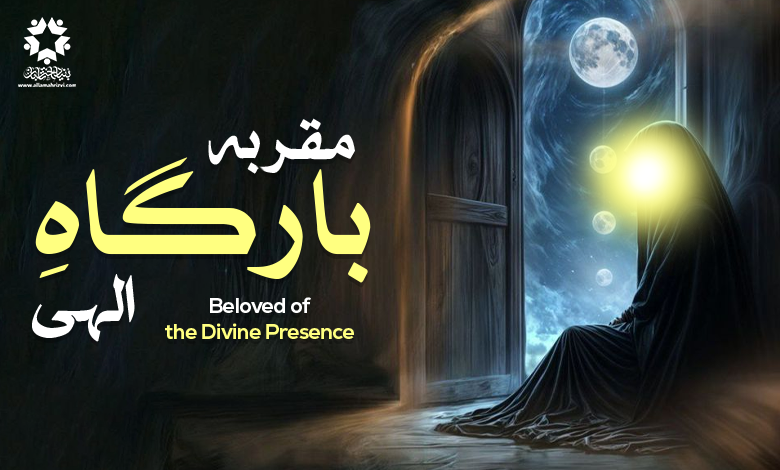
Fatimah (a.s.): The One Closest to the Divine Presence
Fatimah (a.s.): The One Closest to the Divine Presence
Allah, in the Noble Qur’an, while describing the delights of Paradise for the righteous, states:
“Nay! Indeed, the record of the righteous is in ‘Illiyun’—and what will make you realize what ‘Illiyun’ is?—a written register, witnessed by those brought near [to Allah]. Indeed, the righteous will be in bliss.” (Surah Al-Mutaffifin, verses 18–22)
Regarding the term “those brought near” (al-Muqarrabun) in these verses, Imam al-Sadiq (a.s.) said:
“The ‘Muqarrabun’ refer to the Messenger of Allah (s.a.w.), Amir al-Mu’minin (a.s.), Fatimah (a.s.), al-Hasan (a.s.), and al-Husayn (a.s.).”
(Tafsir Ahl al-Bayt, vol. 17, p. 462; Tafsir al-Qummi, vol. 2, p. 410; Bihar al-Anwar, vol. 36, p. 145)
Similarly, in another narration, Imam al-Hasan (a.s.) stated:
“Whenever the Qur’an mentions ‘the righteous’ (al-abrar), it refers to us, the Ahl al-Bayt (a.s.), for we are righteous by virtue of our fathers and mothers; our hearts are elevated through obedience and virtue, detached from this world and its love; we have fulfilled all of Allah’s obligatory commands, believed firmly in His Oneness, and fully affirmed His Messenger (s.a.w.).”
(Tafsir Ahl al-Bayt, vol. 17, p. 462; Al-Manaqib, vol. 4, p. 2)
From these Qur’anic verses and narrations, it becomes evident that Lady Fatimah al-Zahra (a.s.) and the Ahl al-Bayt (a.s.) are the true embodiments of “the righteous” (al-abrar) and “those brought near” (al-muqarrabun). Through purity, perfect faith, obedience to God, asceticism, and detachment from worldly attachment, they attained the highest station of divine nearness—an existential and moral perfection unmatched.
This nearness is neither due to lineage nor a mere honorific gesture; rather, it is the fruit of their deeds, beliefs, sincerity of heart, and spiritual purity. Thus, they stand as the criterion of righteousness and the very fountainhead of guidance.
It is incumbent upon every believer to—on the level of belief—acknowledge them as the Qur’anic “Muqarrabun,” and—on the moral plane—adopt their character as the guiding ideal of life: purifying the heart from love of this world, nurturing a passionate desire for obedience to Allah, and walking the path of spiritual nearness so as to draw oneself closer to both these luminous figures and to God.
The life of Lady Fatimah al-Zahra (a.s.) is the radiant, living example of this path. Through her practical embodiment of divine closeness, she remains, to this day, the supreme model of righteousness, purity, and authentic faith for every believer.






One Comment