Fatimah (SA); Her Unique Representation
Fatimah (SA); Her Unique Representation
When the Noble Prophet (PBUH) engaged in a debate with the Christians of Najran regarding the denial of the divinity of Prophet Jesus (AS), and despite his irrefutable arguments they refused to accept his message, a divine command was revealed instructing him to challenge them to Mubahalah—i.e., mutual invocation of God’s curse upon the party that is lying.
Initially, the Christians accepted the Prophet’s offer of Mubahalah. It was agreed that each side would bring their sons, women, and “themselves” to the field. The Prophet (PBUH) brought Imam Hasan (AS) and Imam Husayn (AS) as his “sons,” Lady Fatimah al-Zahra (SA) as his “women,” and Imam Ali (AS) as his “self.” On the day of Mubahalah, Imam Husayn (AS) was in the Prophet’s arms, Imam Hasan (AS) held his hand, Lady Fatimah (SA) stood right behind the Prophet (PBUH), and Imam Ali (AS) stood behind her. The Prophet (PBUH) instructed his Ahl al-Bayt (AS): “When I make the supplication, say ‘Ameen.’”
Upon seeing these radiant, divinely illumined faces, the bishop of Najran turned to his people and said: “If these people pray to Allah to move a mountain from its place, it will surely move. Do not proceed with Mubahalah! Otherwise, we shall all be destroyed, and not a single Christian will remain on earth until the Day of Judgment.” Ultimately, they refused to carry out the Mubahalah and opted instead to remain in their faith by agreeing to pay the jizyah (poll tax).
The event of Mubahalah occurred after the revelation of verse 61 of Surah Al-Imran. Many authentic narrations explaining this verse emphasize the unparalleled virtues and merits of Ahl al-Bayt (AS). Abu Sa‘id al-Khudri reports: “When this verse was revealed, the Messenger of Allah (PBUH) summoned Ali (AS), Fatimah (SA), Hasan (AS), and Husayn (AS) and said: ‘O Lord! These are my Ahl al-Bayt!’” This clearly shows that the terms “our sons,” “our women,” and “ourselves” in the verse specifically refer to these four Infallibles (AS)—since the Prophet (PBUH) chose only them.
Although the verse uses plural pronouns—suggesting that many individuals could have been brought—the Prophet (PBUH), by divine command, selected only these four for the Mubahalah. This proves that no one was more truthful or sincere than them. Thus, Islam’s great spiritual victory over the Christians was achieved solely through the presence of Lady Fatimah (SA), her father (PBUH), her husband (AS), and her sons (AS).
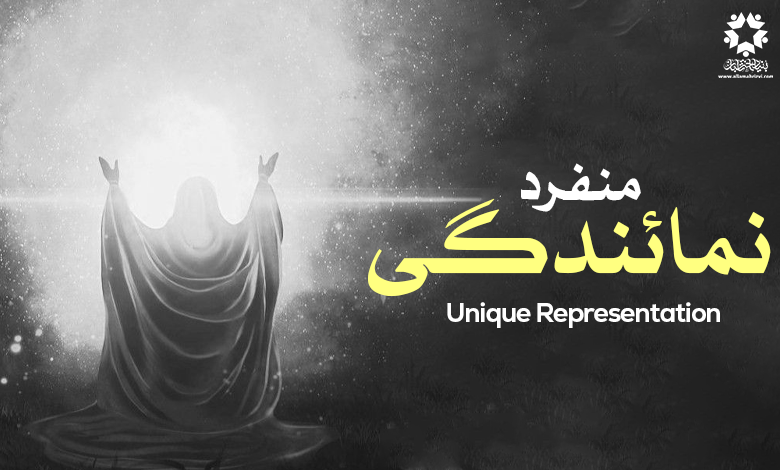
Lady Fatimah al-Zahra’s (SA) presence as the sole female representative in the Mubahalah also declares unequivocally that no woman was more virtuous or worthy to represent all Muslim women. She alone stood on behalf of the entire Ummah’s women.
(For further details: Tafsir Ahl al-Bayt, vol. 2, p. 608; Bihar al-Anwar, vol. 37, p. 264, and vol. 39, p. 315)